Statement of Purpose vs Personal Statement vs Research Statement
These documents can sound interchangeable, but the application form decides what you must submit. Use the institution’s current instructions first, then choose evidence that answers its actual prompt.
Short answer: a statement of purpose usually connects your academic preparation, interests and future goals to one programme. A personal statement usually puts more weight on the person and experiences behind that direction. A research statement explains the question or field you want to investigate, what you have already done and why the proposed work is feasible. Universities may use these names differently. Never substitute one document for another without checking the live admissions page.
Three documents, three jobs
| Document | Question it should answer | Best evidence | Common mistake |
|---|---|---|---|
| Statement of purpose (SOP) | Why this field and programme, and why are you prepared? | Relevant study, projects, work and a specific next step. | Listing achievements without explaining the direction that connects them. |
| Personal statement | What shaped your motivation and readiness? | A selective experience, reflection and evidence of growth. | Writing a life story that never explains programme fit. |
| Research statement | What research interests or questions can you develop? | Prior methods, problem framing, literature familiarity and feasible direction. | Presenting an unsupported PhD proposal or pretending a question is already settled. |
NYU Abu Dhabi’s graduate application guidance distinguishes a personal statement’s personal framing from an SOP’s academic trajectory. That is helpful orientation, but the named programme’s prompt and portal still govern your submission.
Read the institution’s actual requirements
KAUST, Saudi Arabia: its entry requirements describe an approximately 750-word statement of purpose covering past work, preparation, background, academic plans and career objectives, plus reasons for the programme. This is a concrete brief: a generic “I have always loved science” introduction uses valuable space without addressing preparation or fit.
MBZUAI, UAE: its current graduate admissions page lists an SOP for applicants and a separate research statement for PhD applicants, uploaded as PDFs. A PhD applicant should therefore check both prompts rather than turning one document into a longer version of the other. Programme requirements and upload formats can change, so recheck the exact route when applying.
Across the GCC: some programmes request a “personal statement of interest,” some an SOP, and some additional research material. The label alone is not enough. Copy the full prompt, word or page limit, file type and deadline into a small brief before drafting. If two statements are requested, ask what each document must contribute that the other will not.
Turn the prompt into your own evidence-led draft
- Underline the verbs. “Explain your motivation,” “describe preparation” and “outline research interests” are different tasks. Make a one-row checklist for each.
- Choose two or three truthful examples. A project, a method you used, a professional problem you encountered or a question from a thesis is stronger than broad enthusiasm.
- Connect each example to the programme. Identify a relevant curriculum, research area or capability from the institution’s official site. Avoid invented faculty fit or copied lab descriptions.
- Write the next step plainly. Say what you hope to learn or investigate and why it follows from your evidence. You do not need to claim a guaranteed result.
- Edit for the required document. An SOP needs a coherent academic direction; a personal statement needs selective reflection; a research statement needs a defensible research interest.
A worked contrast
Weak, generic line
“I am passionate about artificial intelligence and your prestigious university will help me achieve my dreams.” It could be sent anywhere.
Stronger, fictional example
“While testing an Arabic-language classification model for my final-year project, I found that the training examples underrepresented Gulf dialects. That limitation led me to study evaluation methods for multilingual systems and to seek graduate training where I can test models against more representative data.” The applicant must replace this fictional example with their own real work and verify that the target programme actually supports the proposed direction.
Different research-statement treatment: the same applicant would describe the question, dataset constraints, methods already tried, possible evaluation plan and uncertainties. It would not simply retell the personal motivation paragraph.
Before you upload
- Confirm the current official programme page and the exact portal prompt; save the date you checked it.
- Check document count, requested language, word or page limit and file format.
- Make every project, role, award and technical claim consistent with your CV and transcripts.
- Remove programme names left from another application.
- Verify references to faculty, labs or courses on the institution’s site.
- Ensure your own voice and experiences remain in the final statement. Follow the institution’s rules on outside editing and AI tools.
- Open the exported PDF and check all pages, fonts and file name before uploading.
Frequently asked questions
Can I use the same statement for KAUST and MBZUAI?
Use one evidence bank, not one unchanged document. KAUST publishes an approximately 750-word SOP brief; MBZUAI lists an SOP and, for PhD applicants, a separate research statement. Address each current prompt.
Is a research statement the same as a research proposal?
Not automatically. A statement may ask for interests and prior work, while a proposal may demand a fuller problem, method and plan. Follow the programme’s wording and format.
Can an editor help with a statement?
Only within the institution’s rules. Labeeb can review applicant-authored material for clarity and structure; the applicant supplies the experiences, motivation and substantive claims.
For a broader institution-by-institution starting point, see our GCC university applications guide. Always verify the current official requirements before submission.
Get a compliant review of your own draft
Already written your application statement? Labeeb’s admissions document support can review the structure, clarity and compliance of your own draft against the programme brief. We do not invent experiences, write a personal statement from a blank page or promise admission.
More Academic Support guides
 How to Cite UAE and GCC Government Reports in APA 7
 Data Availability Statements for Journal Articles: A Practical GCC Researcher Guide
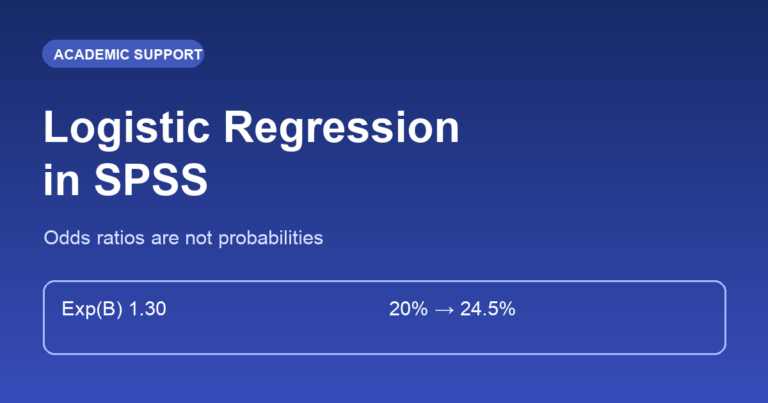 Logistic Regression in SPSS: How to Read Odds Ratios Without Confusing Them With Probability
 Journal Submission Cover Letter: Explain Your Manuscript’s Fit Without Overclaiming