Planning Arabic-English Social Content for UAE and GCC Buyers
A bilingual social plan should help each audience understand the same verified offer in natural language. Choose language, market and channel from real buyers rather than translating every post line by line.
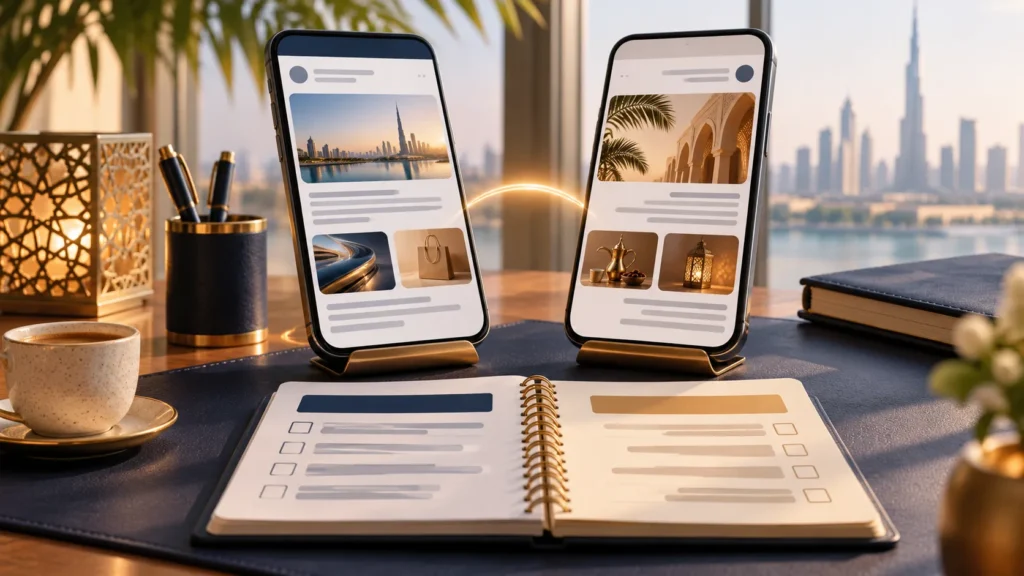
Which readers need Arabic, English or both?
List the buyer groups, decision makers and countries you actually serve. A procurement manager in Saudi Arabia, a founder in Dubai and a research collaborator in Qatar may have different questions even when they can all read English. Review enquiries, sales calls and website landing pages for the language customers use. Do not assume one language performs better across all six GCC markets without evidence.
Give each post a job: explain a service, answer a common buyer question, show permissioned proof or guide someone to a consultation. A post that has no relevant service or next step may attract reactions without qualified conversations.
Localise the message, not just the words
- Start with one approved fact sheet: service scope, market, claims, proof, pricing status and contact route should be consistent.
- Write for the audience: adapt examples, terms and questions to the reader while keeping the underlying facts identical.
- Use native review: have a qualified Arabic reviewer check terminology, tone, names and right-to-left design before release. A machine translation is a draft, not a publication sign-off.
- Choose a format: a short post, carousel, case note or video should fit the information and the team’s ability to produce it well.
- Check the handoff: link to the relevant service page or consultation route, and confirm that the landing page supports the language and question raised in the post.
Not every English post requires an Arabic twin. If the search or enquiry evidence differs, create a separate market-specific answer rather than a duplicate translation. Keep a shared glossary so the service name and promise do not drift between versions.
Make a post useful to a real buyer
Generic post: “We deliver professional business documentation across the GCC. Contact us for all your needs.”
More useful: “If a UAE supplier profile is being prepared for a specific tender, check whether the buyer asks for licence scope, similar projects and bilingual evidence. A marketing brochure alone may not satisfy the document list. Share the relevant RFP section before we scope writing support.”
The example is a content pattern, not a claim that every tender has those requirements. The Arabic version should be written and reviewed for its intended audience, not produced by replacing English words in the artwork.
Judge the posts by qualified discovery
Track the landing page, contact method and the question a new enquiry brings. Compare meaningful service-page visits and genuine conversations with the effort to create each language version. Platform views and likes are useful context, but they are not customer evidence by themselves.
For a B2B team using LinkedIn, review whether posts lead to relevant company-page visits, service-page clicks or inbound conversations. Keep personal professional profiles distinct from the company page. Use a small, repeatable schedule your team can maintain and revisit the topics when customer questions change.
Should Arabic and English appear in one post?
It depends on length, platform and the audience’s reading experience. A concise bilingual announcement may work; detailed advice is often easier to read as separate versions. Test on mobile, especially line direction and artwork.
Will bilingual content guarantee more reach?
No. Relevance, distribution and buyer demand matter. Translate only where the intended reader and commercial route justify the effort.
Connect the right language to the right service.
Share your target audience, existing posts, service pages and customer questions. Labeeb can discuss bilingual business content or LinkedIn page management scope and provide a customised quotation after a brief.
 The Science of Hashtags: UAE Reach Strategy 2026 | Labeeb
 Social Media Branding: Building a Consistent Identity Across All Platforms (UAE, 2026)
 Influencer Marketing in the UAE (2026): How to Collaborate Effectively
 Facebook Ads vs Instagram Ads for UAE SMEs (2026): Which Works Better?