Brand Identity Design Brief for UAE Businesses: A Copyable Worksheet
Before asking for a logo, describe the business decision the identity must support. This worksheet helps a founder or marketing team brief design for English and Arabic touchpoints without substituting taste for evidence.
A logo is one asset. A brand identity is the set of rules and materials that lets customers recognise the same organisation on a website, company profile, proposal, social page, signage and documents. A good brief tells a designer what the organisation does, who needs to trust it, where the identity will appear and who can approve it. It should also state what is out of scope. Without that, two attractive logo options may solve different problems and be impossible to evaluate fairly.
First decide whether you need a logo, a refresh or a system
A new organisation may need its first mark, type, palette and a few core applications. A growing business may already have a recognisable logo but inconsistent PowerPoint, proposal and social templates. A rebrand may require a change in positioning as well as design. Tell the team which problem you have. List the existing assets that must remain and the channels where inconsistent presentation is costing clarity.
Identity rules have practical value. The UAE Federal Government Visual Identity Guidelines show how a large organisation governs use of its mark across materials; they apply to federal entities, not to private UAE firms. A private company’s guide can be simpler, but it still needs approved versions, spacing, colour, typography and examples for daily use. If the identity uses both Arabic and English, the W3C right-to-left authoring guidance is a useful technical reference for digital handoff, while Arabic typographic quality needs a competent reviewer.
Copyable brand identity brief
Fill each line with the answer you can defend. Mark unknowns rather than asking the designer to invent a market position, customer evidence or legal permission.
| Question | Your answer | Evidence or decision owner |
|---|---|---|
| What does the business offer, and what does it not offer? | [One plain-language sentence; important exclusions] | [Approved service catalogue] |
| Who must understand and trust it first? | [Buyer roles, language, location and use case] | [Customer conversations or research] |
| What should customers remember? | [One credible distinction, not a slogan] | [Founder/marketing approval] |
| Where will the identity appear? | [Website, proposals, profiles, signage, uniforms, packaging, slides] | [Application owner and file specs] |
| What already exists? | [Current logo, colours, registered marks, photography, templates] | [Source files and usage rights] |
| Which languages and scripts? | [English, Arabic, both; who reviews Arabic] | [Named language approver] |
| What deliverables are needed? | [Logo variants, colour/type rules, editable templates, exports, mini guide] | [Procurement scope] |
| Who decides and when? | [Decision maker, review rounds, deadline and approval sequence] | [Project owner] |
Attach three to five examples of applications that matter to your business, explaining what works and what does not. “Make it premium” is not a testable direction. “The bilingual company profile must be readable by procurement managers on screen and as a printed PDF” is.
Fictional example: a UAE engineering consultancy
Scenario only: A small engineering consultancy wins work through proposals. It has a logo but no consistent document system. Its first audiences are procurement teams and project directors in the UAE; it also presents to Arabic-speaking partners. The priority is a clearer proposal cover, capability profile, slide template and bilingual name treatment. Vehicle wraps and retail packaging are out of scope.
A useful identity direction might be “precise, dependable and legible in technical documents,” backed by the actual sectors served and approved project evidence. The test is whether the same system works on a one-page proposal cover, a dense engineering slide and a mobile website header in both scripts. The designer should not invent certifications or use photographs of projects without permission. The company’s Arabic reviewer should approve the name and typography before the system is declared finished.
Approve the system in real applications
- Check the primary and reversed logo on light and dark backgrounds, at small sizes.
- Review English and Arabic name treatments separately and together; do not assume one script scales like the other.
- Test at least the website header, company profile cover and presentation title slide.
- Confirm editable master files, export formats and rights to supplied fonts, images and artwork.
- Document the approved colour values, type hierarchy, spacing and incorrect uses.
- Name the person who will manage future changes so templates do not drift.
If your organisation is using a government emblem or another party’s protected mark, obtain the relevant permission and follow that owner’s rules. A designer should not infer authorisation from a visual reference.
Frequently asked questions
Is a logo enough for a small business?
It may be enough for an immediate simple use, but repeated customer-facing documents usually benefit from a few consistent rules and editable templates. Choose deliverables from actual uses.
Should Arabic be added after English approval?
Plan both from the start if both audiences matter. Later Arabic adaptation may change spacing, hierarchy and lockups, and needs language review.
How do I compare design options?
Test each against the same audience, application and scope in the brief. Record reasons for approval instead of voting only on personal preference.
Brief the identity your business needs
For a new identity or a consistent system across proposals, presentations and bilingual materials, explore Labeeb’s brand identity and design service. We scope deliverables and review rounds before work starts; design cannot guarantee commercial results.
 How to Estimate UAE Market Size Using Official Data: A Practical Method
 Bilingual Website Copy Brief for UAE Businesses: English and Arabic Checklist
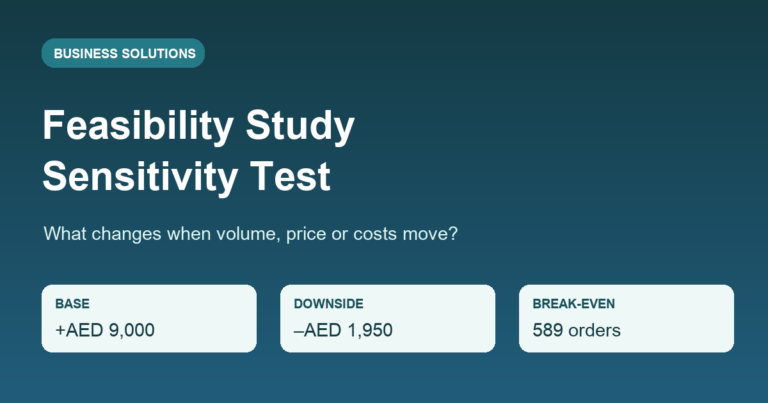 Feasibility Study Sensitivity Analysis for UAE Businesses: A Worked Example
 Build an Annual Report Evidence Register Before Writing the Narrative