Labeeb Original Data · Edition 1.1 · last checked 22 September 2026
Labeeb GCC Salary Index 2026
What official statistics actually say about pay in the UAE, Saudi Arabia, Qatar, Kuwait, Oman and Bahrain — and where no official number exists at all. Verified anchors, pay-system structures and market analysis, with sources you can check.
How to read this index
Most “GCC salary guides” blend survey marketing with guesswork. This index separates three layers and never mixes them.
1. Official wage anchors. Figures published by national statistics offices and labour regulators — each shown with its exact metric, period, coverage and source. Where a government publishes nothing, we say so plainly: that absence is itself important information.
2. Pay-system structure. The verifiable frameworks that shape take-home value in each market: currency pegs, the zero personal income tax common to all six states, wage-protection systems, nationals’ pension schemes and end-of-service rules.
3. Observed market ranges. Role- and sector-level detail lives in our specialist guides, which are researched separately and linked throughout — this hub does not restate their numbers.
Note that official figures below use different metrics (average vs median), different coverage (all workers vs nationals only) and different periods — they are anchors for each market, not a cross-country league table. Basic salary and gross package also differ: GCC packages typically add housing, transport and other allowances on top of basic pay, and end-of-service accrues on basic salary.
Official wage anchors — latest published
Qatar — about QAR 11,900 / month (2022)
Average monthly wage of all wage-earning workers, about QR 11.9 thousand in 2022 (males QR 11.8 thousand, females QR 12.2 thousand). Source: National Planning Council, Labour Force Sample Survey 2022, the latest wage release Labeeb could open and link. Newer quarterly releases may be listed on the NPC surveys page: check there before quoting a current figure.
Kuwait — KWD 1,592 vs KWD 352
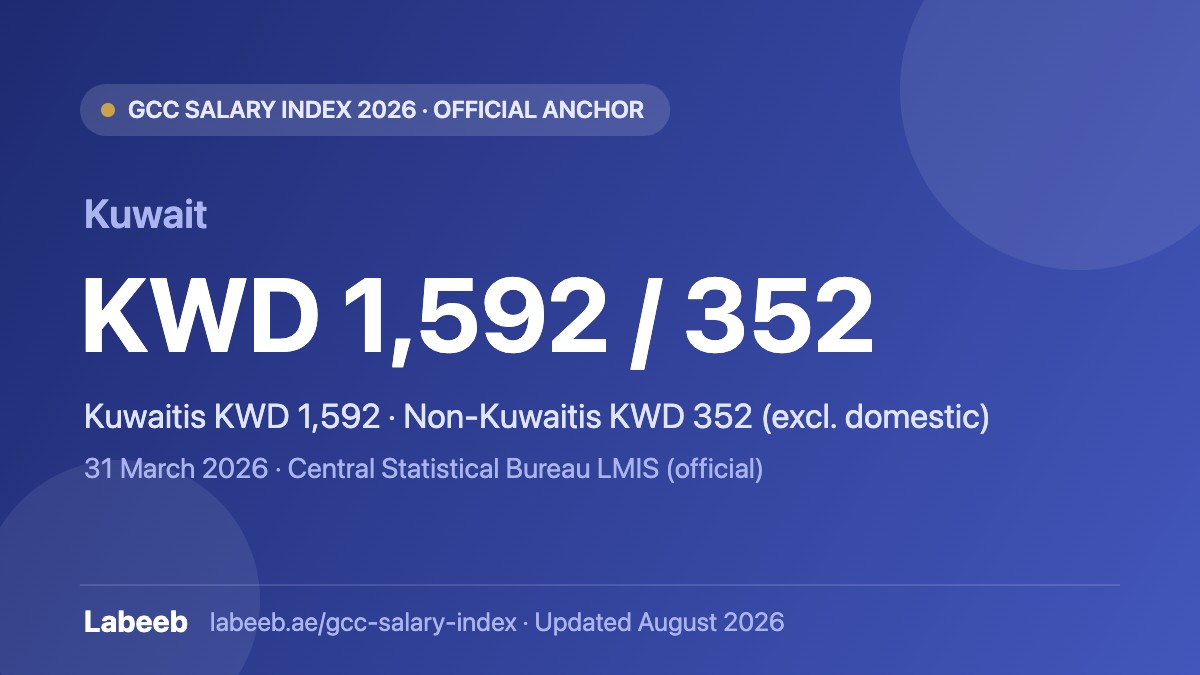
Average monthly wage by nationality (Kuwaitis vs non-Kuwaitis), excluding domestic workers, as at 31 March 2026. Source: Central Statistical Bureau, LMIS (figures reported by Times Kuwait, July 2026).
Bahrain — BHD 575 / month (median)
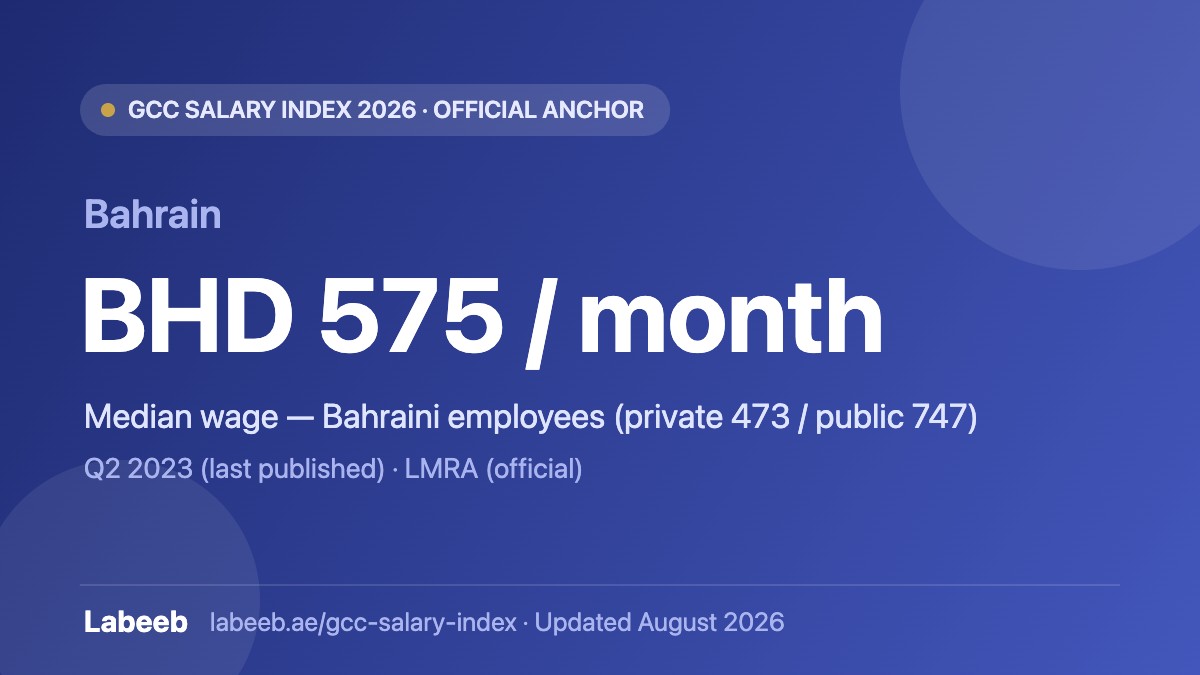
Median monthly wage of Bahrainis — private sector BHD 473, public sector BHD 747. Q2 2023. Source: LMRA, Labour Market Indicators, Second Quarter 2023, based on Social Insurance Organization data. This is the latest LMRA wage release Labeeb could confirm; check LMRA for newer releases.
Saudi Arabia — SAR 5,795 / month
Average monthly wage of paid employees in their main job, Q4 2025: SAR 5,795 overall; Saudis SAR 11,103; non-Saudis SAR 4,131. Source: General Authority for Statistics (GASTAT), Labour Market Statistics Q4 2025, as tabulated by the Gulf Labour Markets and Migration programme; the primary bulletin is on stats.gov.sa.
UAE — no official aggregate
The Federal Competitiveness and Statistics Centre publishes labour-force statistics, but no economy-wide average wage. Every “UAE average salary” figure you see is a commercial-survey estimate, not an official statistic. Our observed-market guides cover what employers actually pay, role by role.
Oman — no official aggregate
The National Centre for Statistics and Information publishes wage-bracket distributions for insured Omanis rather than an average or median; see the current tables on ncsi.gov.om. No economy-wide official aggregate exists.
Findings you can cite
- Qatar’s latest official all-worker average that Labeeb could link is about QAR 11,900 a month in 2022 (National Planning Council, Labour Force Sample Survey 2022).
- Kuwait’s official data shows a 4.5× nationality gap — KWD 1,592 for Kuwaitis vs KWD 352 for non-Kuwaitis (CSB, Q1 2026, excluding domestic workers).
- Only Bahrain publishes an official wage median (BHD 575, Bahrainis) — from its Q2 2023 wage release, the latest Labeeb could confirm.
- Neither the UAE nor Oman publishes an economy-wide official average wage; UAE market figures rest entirely on commercial surveys.
- Salaries carry zero personal income tax in all six GCC states; nationals contribute to state pension schemes (GPSSA, GOSI, GRSIA, PIFSS, Social Protection Fund, SIO).
- Wage-protection or monitored salary-transfer systems operate across the GCC, starting with the UAE’s WPS in 2009. Coverage and rollout dates differ by country: check the national labour ministry.
Cite as: Labeeb GCC Salary Index 2026, Edition 1.0 (August 2026), labeeb.ae/gcc-salary-index/ — citation with a link is permitted and appreciated.
How pay is structured, market by market
United Arab Emirates
AED, pegged at 3.6725/USD · 0% income tax · WPS via MoHRE since 2009 · GPSSA pension for nationals (ADPF in Abu Dhabi) · end-of-service gratuity on the 21/30-day basic-salary formula (DIFC runs the funded DEWS plan) — full calculation guide · free settlement calculator · all tools: labeeb.ae/tools · Emiratisation quotas.
Saudi Arabia
SAR, pegged at 3.75/USD · 0% income tax · WPS via Mudad/Qiwa · GOSI pension and insurance · statutory end-of-service award scaling with service length · Saudization (Nitaqat) shapes hiring and pay bands.
Qatar
QAR, pegged at 3.64/USD · 0% income tax · WPS via the Ministry of Labour · GRSIA pension for nationals · statutory end-of-service on basic pay · Qatarization in key sectors.
Kuwait
KWD, basket-pegged — the strongest GCC currency · 0% income tax · PAM-monitored salary bank transfers · PIFSS pension for nationals · statutory end-of-service indemnity scaling with service · Kuwaitization targets.
Oman
OMR, pegged (1 OMR ≈ USD 2.60) · 0% income tax · WPS run by the Ministry of Labour (check current coverage) · Social Protection Fund · expatriate end-of-service transitioning to savings-scheme contributions under the Social Protection Law · Omanisation.
Bahrain
BHD, pegged (1 BHD ≈ USD 2.66) · 0% income tax · WPS via LMRA phased from 2021 · SIO pension for nationals · expatriate end-of-service paid through monthly employer contributions to the Social Insurance Organization since 1 March 2024 (EY summary) · Bahrainisation.
Where the money actually is — Labeeb analysis
UAE. The deepest and most stratified market: flagship employers and semi-government entities anchor the top of the market, aviation and infrastructure programmes such as Etihad Rail and the DWC expansion drive specialist demand, and executive packages are increasingly structured. Benchmark affordability with our family cost-of-living guide and public-sector pay overview.
Saudi Arabia. Giga-projects and energy set the pace: see software engineering bands by level, civil & mechanical engineering demand and how expat packages are negotiated.
Qatar. Energy, finance and major-programme delivery dominate the top band; NPC’s 2022 survey records the highest average wages in mining and quarrying and in public administration.
Kuwait. Oil and gas remains the premium employer — our Kuwait energy career guide covers how KOC, KNPC and the majors structure packages.
Oman & Bahrain. Smaller markets with focused premium pockets — energy and logistics in Oman; banking, fintech and luxury hospitality in Bahrain. Official aggregates are limited (see anchors above), so role-level judgement matters more, not less.
Methodology & limitations
Sources. Official anchors come only from national statistics offices and labour regulators (NPC Qatar; CSB Kuwait; LMRA Bahrain; GASTAT Saudi Arabia; FCSC UAE; NCSI Oman), each re-checked on 22 September 2026 and linked to the release it comes from. Structural facts are compiled from the states’ own legal frameworks. Market observations come from Labeeb’s specialist guides, which are researched and sourced separately.
What we will not do. We do not invent figures, average incompatible metrics, or fill gaps to complete a table. Where a state publishes nothing, the index says so — UAE and Oman are shown as not published, and Qatar shows the latest release we could open and link.
Limitations. The anchors differ in metric (average vs median), coverage (all workers vs nationals; sectors included) and period (2022 to Q1 2026). They describe each market individually and must not be read as a cross-country ranking. Government portals sometimes restrict automated access; primary bulletins remain the authoritative record.
Versioning. Edition 1.0, published 19 August 2026. Edition 1.1, 22 September 2026: Qatar and Saudi anchors relabelled to linked releases, Bahrain end-of-service body corrected, unlinked Oman figures removed. We review quarterly as new official releases appear. Corrections: contact@labeeb.ae.