Qatar Job Interview Questions: Prepare Role Evidence, Not Memorised Answers
The strongest answer is usually a truthful example tied to the vacancy, not a script copied from an online question list. Use the employer’s stated process, your real work and a concise evidence framework to prepare.
How should you prepare for a job interview in Qatar?
Read the actual vacancy and invitation first. Identify the responsibilities the employer is most likely to test, select a real example for each, and practise explaining your decision, action and result in plain language. Prepare to clarify your contribution, tools, constraints and lessons. Confirm whether the meeting is online or face to face, its time zone and any requested assessment. No public list can predict the exact questions or scoring method for every Qatar employer.
Qatar Foundation’s careers information says shortlisted applicants may be contacted for a video or face-to-face interview. QatarEnergy’s applicant FAQ says its recruitment team contacts candidates whose resumes suit a vacancy and describes pre-employment checks. These are employer-specific process statements; use your own invitation as the authority for your interview. Labeeb is independent of both organisations and does not recruit or place candidates.
Turn the job description into an interview evidence map
Highlight four or five duties that matter most to the role. For each one, find an example you can substantiate from paid work, an internship, an approved university project or volunteering. The example should show what you did, not only what the team achieved. If you are a graduate, a supervised project can be useful when you explain its scope honestly. If your past work is confidential, remove client names and protected figures while keeping the decision process clear.
| Vacancy signal | Evidence to select | Question to practise | What to avoid |
|---|---|---|---|
| Customer resolution | A real complaint, your response and a documented outcome | How did you handle a difficult customer? | Claiming the entire team’s result as yours |
| Safety or quality | A risk noticed, escalation and preventive action | What did you do when a process was unsafe? | Sharing restricted incident details |
| Analysis | A decision based on data, with limits explained | How did you check a conclusion? | Inventing precise metrics |
| Collaboration | A disagreement resolved through clear roles | How did you work across teams? | Blaming a colleague |
This is a preparation tool, not a claim that every employer asks those questions. Role-specific technical tests may require a different kind of demonstration. Choose evidence that the vacancy makes relevant rather than memorising every prompt in a generic article.
Give a direct answer, then a concise real example
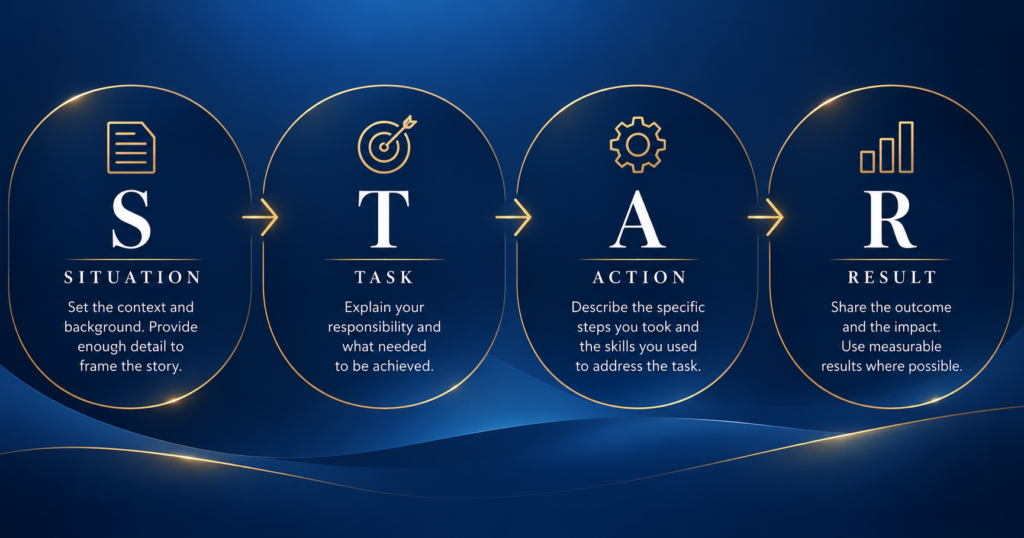
A practical behavioural answer can use situation, task, action and result. The University of Southampton’s interview guidance recommends a STAR/CAR structure where appropriate. It is a communication aid, not a substitute for technical reasoning. State the outcome accurately, including what remains uncertain. For a question about motivation, answer directly before supplying a short supporting example. For a technical problem, explain assumptions, trade-offs, checks and the point at which you would ask for specialist review.
Context
What was the problem, in one or two sentences?
Your action
What did you personally decide and do?
Outcome and learning
What changed, what can you verify and what would you improve?
A useful self-check is to ask whether the answer still makes sense without a company name or an impressive-sounding number. If it does, the reasoning is probably clearer. If an interviewer asks a follow-up, answer it rather than returning to the script. You may use notes, but do not read a rehearsed paragraph as though it were spontaneous experience.
Replace a vague “teamwork” claim with a defensible account
Imagine a fictional Doha operations coordinator asked, “Tell us about a time you solved a delivery problem.” A weak response says: “I always solve problems fast and improved delivery by 50%.” It lacks context, personal action and a verifiable basis for the percentage. A stronger response would say: “During a weekly dispatch, two customer orders were assigned to the wrong route. I checked the order references against the route sheet, alerted the supervisor before vehicles departed and called the affected customers with revised windows. We corrected the assignments that day. I then proposed a second reference check at handover; my supervisor adopted it for the following shift.”
The stronger answer makes the candidate’s role clear without inventing a metric. It also leaves room for the interviewer to ask how the references were checked, who authorised the change and what happened later. If the candidate has actual documented turnaround or error figures, they can add them with the correct period and denominator. If not, a truthful qualitative result is better than an impressive but unsupported number.
For a graduate, the same principle applies to a group project. Explain the assigned part, method, feedback and individual contribution. Do not present a classroom simulation as a live employer project. The interviewer is assessing judgement as well as achievements.
Use official employer routes and guard against recruitment scams
Apply through the employer’s current advertised route. Qatar Foundation states that it and approved recruitment suppliers do not charge job seekers recruitment fees. QatarEnergy directs job applicants to its career portal rather than unrelated email addresses. These sources are useful when checking whether a purported interview invitation is connected to a real vacancy. The rules and channels of another employer may differ, so verify the sending domain, job reference and contact path on the employer’s own site.
Do not pay a stranger for a promised interview or share passport copies and financial details through an unverified chat. If the invitation changes location, format or document requirements, confirm through the official careers contact. This guidance is about prudent verification; it does not diagnose any particular message as fraudulent.
For roles that require licensing, registration, language proficiency or a portfolio, follow the vacancy requirements. A generic “Qatar interview questions” list cannot replace that preparation. Our Qatar CV-format guide can help you reconcile your application and interview evidence; keep dates, titles, qualifications and claims consistent across both.
Prepare four kinds of questions without pretending to know the panel
- Role fit: Why does your experience match the duties? Connect two or three requirements to specific evidence.
- Behaviour: Describe a setback, conflict or deadline. Explain your own action and a truthful result.
- Technical judgement: Walk through a realistic role problem. State assumptions and check them; say when you would escalate.
- Motivation and logistics: Explain why this role and employer fit your goals; know your genuine availability and work-authorisation situation without making assumptions about eligibility.
Write prompts rather than polished paragraphs. Record a brief practice answer and listen for jargon, unsupported numbers and missing action. Aim to make your reasoning easy to follow. If the employer’s process includes a case exercise, ask about the allowed preparation materials and submission format. Use original work and cite any external material; do not present generated or borrowed answers as personal experience.
Questions for the panel should be relevant and respectful: what success looks like in the first months, which team owns the outcome, and what the next stage involves. Avoid asking questions already answered clearly in the vacancy solely to fill time. If an interviewer cannot disclose confidential details, accept the boundary.
Use this 24-hour interview checklist
- Open the actual vacancy and invitation; confirm location, format, time zone and requested documents.
- Compare your CV, application and online profile for consistent dates, roles and qualifications.
- Choose four evidence examples and check which results you can substantiate.
- Practise one concise introduction and one follow-up answer for each key duty.
- For video, test sound, camera, lighting, connection and a quiet location.
- For an in-person interview, plan travel and arrival with a realistic buffer.
- Prepare two useful questions and a truthful explanation of availability.
- Keep confidential client, employer and participant data out of notes you share.
Afterward, record which topics were difficult while memory is fresh. If you send a follow-up, keep it brief and use the contact route given by the employer. A courteous follow-up is not a guarantee of selection. Continue applying for appropriate roles while the employer makes its decision.
Need structured interview practice for a Qatar role?
Bring the real vacancy and your truthful CV. Labeeb can help you organise examples, practise clear answers and identify gaps before the interview. We do not supply leaked questions, impersonate employers or promise placement.
More Career Services guides
 LinkedIn Open to Work Privacy for UAE Professionals: Choose Your Visibility
 How to Ask for a Job Referral in the UAE: A Respectful Message and Application Plan
 Oman Government Job Applications: Match Your CV to the Vacancy Notice
 Cover Letter With No Work Experience for UAE Jobs: Show Evidence You Already Have