UAE Company Profile Template: A Worked Example and Evidence Checklist
A company profile should help a real buyer understand who you are, what you deliver and what you can prove. Use this adaptable structure before spending time on design.
What should a UAE company profile include?
A useful company profile normally identifies the business accurately, explains its products or services, shows relevant delivery capability, gives evidence of completed work or qualifications where permission allows, and makes the next contact step obvious. The order and depth depend on the reader. A tender evaluator wants evidence against a requirement; a prospective partner may first want market fit and operating capacity. No universal page count or document template is an official UAE requirement.
Keep the legal name, licensed activities and identifying details consistent with the company’s own current records. The UAE Government’s licence-verification guide points to official emirate and national checks. For federal supplier registration, the Ministry of Finance describes the actual platform and supporting documentation. A designed marketing PDF is not a substitute for completing any required official registration fields.
Choose the reader before the layout
| Reader | First question | Evidence to emphasize | Common mistake |
|---|---|---|---|
| Procurement or tender team | Can this supplier meet the scope? | Relevant projects, capacity, licences and compliant documentation | Generic slogans instead of requirement-matched proof |
| Corporate client | Can they solve our specific problem? | Service outcomes, process, team roles and credible examples | A long company history before the client need |
| Investor or partner | Is the business model credible? | Market logic, operating model and substantiated milestones | Unverified forecasts presented as results |
| Bank or compliance reviewer | Does the description match the legal business? | Accurate legal identity and requested documents | Assuming a brochure replaces the institution’s own forms |
A master profile can hold approved facts, but the outward-facing version should be tailored to the specific request. Do not invent a client list, certification or years of experience to fill space.
Adaptable company-profile structure
- Cover and identity: legal or trading name as appropriate, brand, document date and a clear descriptor of what the business does.
- One-paragraph overview: customer, problem, core offer, location and an evidence-based differentiator.
- Services or products: group by buyer problem rather than listing every internal department.
- Delivery capability: describe people, process, locations, equipment or partners only where relevant and verifiable.
- Selected work: short project examples with scope, your role, date and an outcome you have permission to disclose.
- Trust and compliance: current licence details, certifications and approvals only where held and appropriate to share.
- Contact and next action: named team or inbox, website, location and a clear way to request a discussion.
Some sectors need specialist sections—safety, quality systems, technical capacity, data protection or local-content evidence. Add them because the intended reader needs them, not because every competitor has a similarly titled page.
Worked example: turn generic copy into verifiable copy
Imagine a fictional Dubai-based facilities-maintenance company seeking corporate clients. The following example is a writing demonstration, not a real supplier or performance claim.
Generic draft
“We are a leading one-stop provider of world-class maintenance solutions across the UAE. We guarantee the best quality and customer satisfaction.”
Evidence-led draft
“We provide planned and reactive facilities maintenance for multi-site offices in Dubai. Our work is organised through a documented request, site assessment, assigned technician and close-out record. Ask us for the relevant trade-licence details, service scope and anonymised examples before procurement review.”
The second version is not impressive because of adjectives. It tells a buyer what service is offered, to whom, how the work is managed and what evidence can be checked. Before publication, the business must replace every sample sentence with its own truthful facts. Where a measurable outcome is used, keep the underlying calculation and permission record.
Illustrative one-page opening
Who we serve: “Atlas Facilities Services” is a fictional Dubai-based firm supporting multi-site office operators that need one documented route for planned and reactive maintenance. This example does not represent a licensed company.
What we deliver: The proposed profile would group maintenance into preventive visits, request-led repairs and reporting, with a process chart showing intake, site assessment, work authorisation, completion record and follow-up. The real business must replace these categories with its licensed and active offer.
Why trust the claim: The profile would list only verified team credentials, current licences and cleared project summaries. It would state how a buyer can inspect the relevant evidence privately. It would not claim a response-time guarantee unless the company actually operates and documents that commitment.
Next step: A corporate buyer could request the service scope and appropriate evidence pack from a named contact. That action is clearer than ending the document with a generic “thank you” page.
A short project box the reader can scan
| Field | What to write | Evidence check |
|---|---|---|
| Client context | Sector and challenge, anonymised if required | Consent or confidentiality approval |
| Your role | Exactly what your team delivered | Contract or delivery record |
| Result | Observed outcome with dates and limits | Traceable metric or documented client feedback |
| Relevance | Why this example resembles the buyer’s need | Scope match, not a vague award claim |
What to verify before design begins
Identity and permissions
Confirm company name, licence information, brand files, approved client references and who can sign off the profile.
Commercial offer
Confirm active services, coverage area, delivery capacity and which claims must be reviewed by operations.
Supporting proof
Collect project records, certifications, team credentials and source files; remove anything outdated or confidential.
The UAE federal supplier register asks suppliers to provide platform-specific information and documents. Check the relevant buyer’s current requirements rather than assuming this PDF alone qualifies a supplier. A profile may introduce capability; the procurement portal, licence record and tender response remain separate artifacts.
Write for two languages without cloning mistakes
English and Arabic versions need the same verified company facts, service scope and date. Yet sentence order, terminology and reader expectations may differ. Prepare a controlled fact sheet first; then write or review the Arabic version with a fluent professional who understands the subject. Check legal names against official records and retain the correct Arabic brand spelling. Do not machine-translate technical claims or use a second-language version that describes services the company no longer provides.
For a GCC audience beyond the UAE, identify which examples, regulations and contacts actually apply in each country. A UAE trade licence does not become a Saudi or Qatari credential merely because a brochure says “GCC-wide.” Distinguish where you are legally established from where you can serve clients.
Design that helps a buyer decide
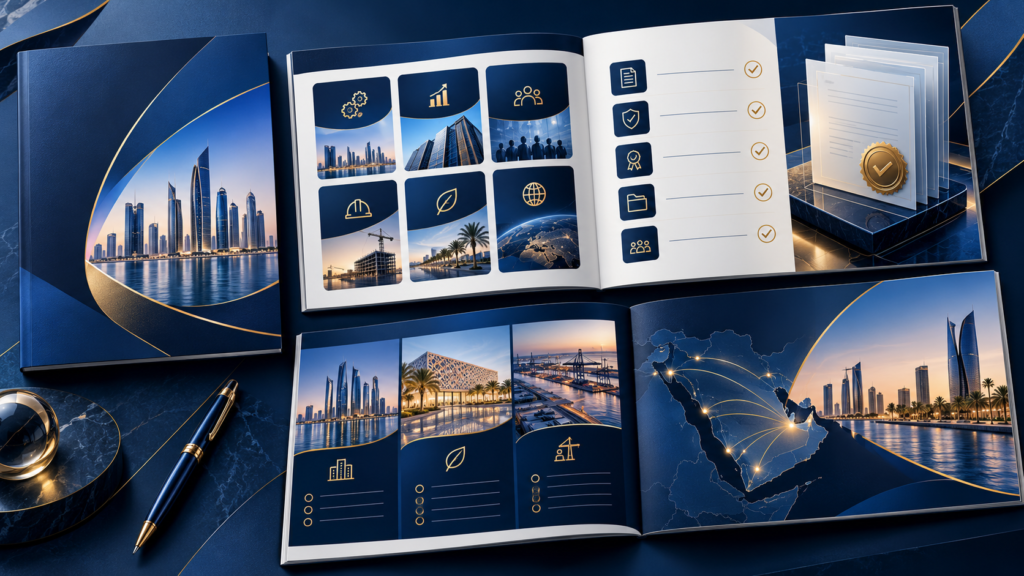
Use a cover that identifies the company, not a stock-photo collage. Put a concise capability summary early. Convert dense service paragraphs into a clear capability grid, but leave enough explanatory text for important scope boundaries. Use project cards to show comparable work and a small process diagram when delivery steps matter. Every chart or icon should explain something real.
Provide an accessible PDF with readable text, high-contrast headings and a working contact link. Check it on a phone: tables should remain legible and call-to-action details should be easy to use. Keep an editable master so approved facts can be updated without rebuilding the profile from scratch. Version the file by date rather than circulating several conflicting “final” copies.
Final profile quality checklist
- Does the first page explain the business in the customer’s language?
- Are legal identity, current licensed activity and geographic claims accurate?
- Can each number, certification, client name and outcome be supported?
- Do service descriptions match what the team currently delivers?
- Are project examples relevant to the target buyer and cleared for use?
- Can a reader find the next contact step in seconds?
- Does the English or Arabic version say the same verified thing in natural language?
- Has the latest version been checked in desktop PDF view and on mobile?
Our Company Profile Writing service can help organise a truthful evidence pack into a reader-focused profile. For a broader project, our Business Solutions hub explains related writing and design support.
Three versions from one approved fact base
A company can maintain one controlled fact file and prepare different reader-facing versions without contradicting itself. This is more efficient than designing one enormous profile that tries to answer every possible request.
| Version | Lead with | Keep available |
|---|---|---|
| General introduction | Who you serve, offer and differentiator | Current contact and service list |
| Procurement capability | Requirement match, relevant projects, delivery capacity | Licence and certifications requested by buyer |
| Partnership discussion | Operating model, market coverage and complementarity | Proof of capacity and named contacts |
The versions share verified legal identity and current facts. They differ in order, depth and examples. Record the intended audience and approval date in each file. If a service or certificate changes, update the fact base first and identify every outward version that depends on it.
Before-and-after project evidence
A claim such as “completed many successful projects” is hard to assess. A better project summary records a client sector, the original problem, the scope delivered, a timeframe and a result you can verify or a qualitative outcome the client permits you to share. If exact figures are confidential, describe the process and scope without inventing a percentage. If the buyer asks for experience in a sector you have not served, describe transferable capability honestly rather than implying a past contract.
Design should make this evidence faster to understand. Give each project card the same fields so a buyer can compare examples; reserve a full page for genuinely relevant complex work. Avoid shrinking text to fit a decorative layout. A short truthful profile can be more useful than a long speculative one.
Sources and limits
- UAE Government: Verify business licences — official routes to check licence details.
- UAE Ministry of Finance: Supplier registration — the official platform and document process.
- UAE Ministry of Finance: Federal Supplier Register — scope of the register and supplier requirements.
The structure and fictional example above are editorial tools, not government forms. Buyer requirements and registration rules vary and should be checked at the time of use.
Make your company profile useful to the buyer
Tell Labeeb who will read the profile, what services are active and which claims you can substantiate. We can scope the writing and design around your actual evidence and consultation-first business goal.
 Saudi Tender Local Content: Match Every Bid Claim to Evidence
 Oman Free-Zone Business Plan: Test the Site Before the Forecast
 UAE Tender Executive Summary: Turn RFP Evidence into a Clear Opening Case
 Bahrain Bourse Investor Relations Website: A Practical 2028 Readiness Guide