CAREER SERVICES · OMAN
Oman CV Format for Jobs: A Role-Matched Example and Application Check
Use a readable CV that proves fit for a specific vacancy. Check the application route and requested fields before deciding what belongs in the file.
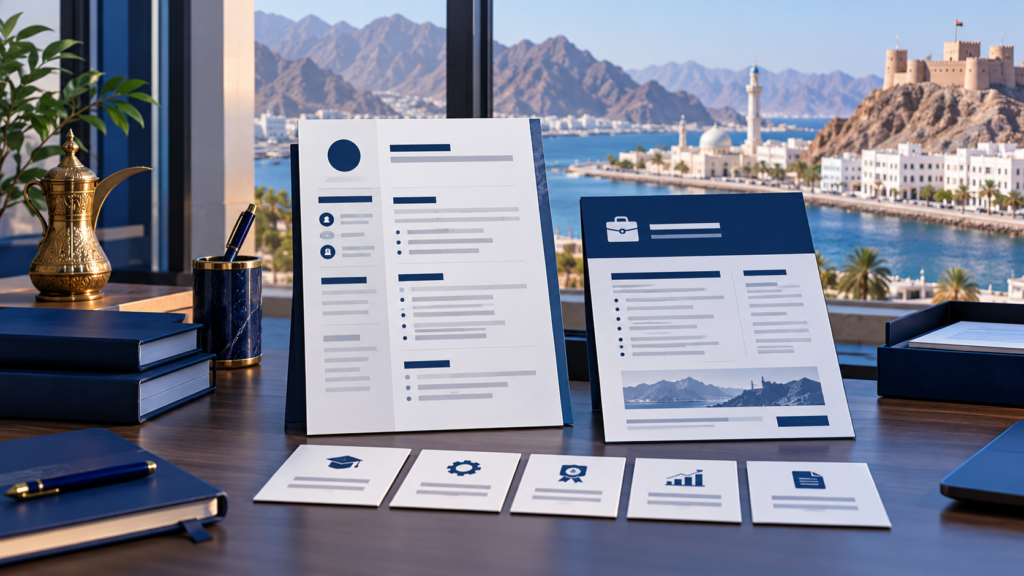
There is no one official Oman CV template for every job. Start with the vacancy or employer application form. Use a clear header, short role-specific profile, relevant experience with evidence, education, and the skills or licences the role actually asks for. Put eligibility and personal details where the particular application requires them; do not assume every private-sector, government, graduate and academic application uses the same fields.
If you are applying for a government vacancy, use the official Oman government job service to find the current route and instructions. Sultan Qaboos University’s Career Guidance Centre offers CV and job-correspondence review, which shows why a draft should be checked against its purpose rather than treated as a fixed form. Neither source sets a universal page count, photo rule or ATS guarantee.
First choose the correct application route
Many “Oman CV format” examples jump straight to fonts and sections. That misses the first decision: will the employer read an uploaded CV, use an online profile, ask for a specific institutional form, or require evidence in separate fields? A polished file cannot replace a required form. Read the full advert, eligibility wording, file type and submission method before writing a new version.
| Application route | What to check first | How the CV helps |
|---|---|---|
| Government vacancy | Current official notice, applicant eligibility, required profile or form and closing date | Prepare truthful role evidence for any requested CV or later assessment; follow the portal instructions |
| Employer career page | Job description, upload fields, requested documents and language | Match the responsibilities and tools you actually know; keep the uploaded file readable |
| University or specialist role | Institution-specific CV structure, publications, credentials and attachments | Follow the named institution’s criteria rather than a generic commercial template |
For example, Sultan Qaboos University’s academic recruitment instructions specify information for the applicant CV and distinguish some role categories. These are SQU instructions, not a rule for all Oman employers. The official Ministry of Labour job system also has distinct services for registration, job opportunities and government vacancies; use the current notice rather than a copied checklist.
A practical Oman CV structure for an ordinary professional vacancy
When an employer simply requests a CV and does not prescribe a format, the following structure gives a reviewer a clear path through your evidence. Adapt it to the role and your history. A graduate may put education and projects before limited work history; a senior professional may lead with scope and recent outcomes. A specialist may need a separate section for licences, technical training or publications.
1. Identity and reachability
Use the name you apply under, current city/country, a working phone number and a professional email. Add a portfolio or LinkedIn link only if current and relevant.
2. Role-focused profile
In two to four concise lines, name your discipline, setting and strongest fit. Avoid claims such as “perfect candidate” or a list of personality adjectives.
3. Experience and evidence
List recent roles with employer, dates and your actual contribution. Use specific tasks, scale and results when verified and shareable.
4. Qualifications and skills
Name completed degrees, relevant certificates, tools, languages and licences accurately. Separate a credential in progress from one already held.
A concise, readable single-column layout is often easier to review and copy from than decorative skill bars or a dense two-column graphic. Yet no source establishes one universal “ATS-approved” Oman CV design. If the employer supplies a template or portal fields, those instructions control. Check that dates, names and titles remain legible in the submitted PDF or editable file.
Worked example: match a Muscat operations vacancy without inventing results
The vacancy and candidate below are fictional. Imagine a logistics coordinator role requesting shipment tracking, supplier contact and weekly exception reports. The applicant has handled dispatch records but cannot substantiate a claimed 30% improvement. Rather than borrow an impressive number, map each requirement to a real action and a document or witness that could support it.
| Requirement from a fictional advert | Evidence the applicant actually has | Possible CV wording |
|---|---|---|
| Track shipment status | Updated a shared dispatch tracker and followed up delayed deliveries | “Maintained the dispatch tracker and escalated late deliveries to the operations lead.” |
| Coordinate suppliers | Confirmed weekly delivery windows with three suppliers | “Coordinated weekly delivery windows with three suppliers and recorded changes for the warehouse team.” |
| Report exceptions | Prepared a weekly list of unresolved delivery issues | “Prepared weekly exception summaries showing open issues and their owners.” |
Each line is useful because it shows an action the candidate could explain at interview. It does not claim a percentage, software package or management responsibility that the evidence does not support. If your company data is confidential, describe your role at an appropriate level rather than revealing client names or private figures.
Weak profile
“Hardworking professional with excellent communication skills, seeking a challenging position.” The employer learns little about the candidate’s actual fit.
Stronger, if true
“Operations coordinator with experience tracking dispatch exceptions, arranging supplier delivery windows and preparing weekly handover reports.” This names the work the vacancy asks about.
For another example of connecting a skill claim to proof, see Labeeb’s vacancy-to-CV skills guide. Its example uses a UAE context, so adapt the method to the actual Oman job description rather than copying its wording.
What about nationality, residence status, a photo and personal information?
These questions appear often in Oman CV templates, but broad internet rules conflict. Some vacancies restrict eligibility or request specific information; others do not. Read the actual posting and form. State nationality, current location or work authorisation truthfully when requested or materially relevant. Do not list passport numbers, identity-card numbers, marital status or a photograph simply because a generic template includes them. Share sensitive documents only through the legitimate process after checking the recipient and purpose.
Government vacancies may have eligibility conditions that differ from private employers or specialist recruitment. The Gov.om government-job service is an official starting point for the current process. It does not mean Labeeb can determine eligibility from a CV. If the posting asks for an institutional form, follow that form even when your own CV is better designed. For an expatriate applicant, ask the employer or competent authority about role and work-authorisation eligibility; do not assume a CV change can resolve a legal restriction.
Photo expectations also vary by employer and channel. If a photo is explicitly required, follow the instruction. Otherwise, decide whether it contributes to the particular application and consider privacy. The most defensible universal advice is to avoid asserting one practice for every employer. Keep the document professional and focused on qualifications the decision-maker can evaluate.
Adjust the evidence by career stage and sector
A graduate without much paid experience can use a placement, capstone, volunteer assignment or documented project, clearly labelled as such. Muscat University describes placement experience as part of preparing students for work; a placement is meaningful when you explain your actual task, not when you present it as full-time employment. An experienced applicant should prioritise recent, relevant scope, tools and decisions rather than describe every early job at equal length.
For technical and regulated roles, record the discipline, licence or certification exactly as held. If an employer asks for a particular credential, do not rename a related one to appear equivalent. For leadership roles, state the mandate, team size, budget or operating scope only if accurate and shareable. If applying to a university or research role, use that institution’s recruitment instructions; a publication list or teaching history may belong in a specialist academic CV even when it would distract from a private-sector operations application.
If you are applying across Oman and another GCC country, keep one accurate career history, then create role-specific presentations. Do not merely replace “Muscat” with another city. Compare the vacancy, employer terminology and submission route for each application. Labeeb’s Oman international CV service covers applications beyond the GCC and has a different destination-market purpose.
Before you upload: a seven-point CV check
- Eligibility: Have you read the current vacancy notice and confirmed the role is one you can apply for?
- Route: Does the employer want a CV, online profile, prescribed form or multiple documents?
- Fit: Can a reader see the target role and your relevant evidence near the start?
- Accuracy: Can you explain every title, date, credential, tool and result at interview?
- Privacy: Have you removed personal identifiers and confidential client details that the application does not require?
- Readability: Can you select and copy the text from the final file, and read it on a phone?
- Submission: Are the filename, language, file type and attachments exactly what the current posting requests?
Ask someone unfamiliar with your history to read the first half-page. They should be able to tell what role you are seeking and what evidence supports your fit. If they cannot, revise the order and wording before adding more design. A CV can improve presentation; it cannot guarantee screening, an interview, eligibility or an offer.
Make your Oman application easy to evaluate
If you have a specific Oman vacancy and an existing CV, Labeeb can help turn your real experience into a clear, role-matched document and identify what needs to be checked in the employer’s instructions. Share the vacancy and your draft so the Career team can recommend the appropriate CV package or a consultation. We do not recruit candidates or promise interviews.
Explore professional CV writing
Need to clarify scope first? Ask Labeeb about your CV.
 CV PDF or Word for UAE Jobs? Choose the File the Employer Can Use
 How to Follow Up After a Job Application in the UAE: Email and Timing
 Skills for a UAE CV: Match the Vacancy and Prove Each Claim
 Qatar Graduate Cover Letter: Turn a Job Requirement into Evidence