ACADEMIC SUPPORT · UAE & GCC
Research Question vs Hypothesis: Choose and Align Your Dissertation
A clear question defines what you need to learn; a hypothesis makes a testable prediction where your design warrants one.

A research question asks what a study will investigate. A hypothesis states a specific, testable expectation about a relationship or difference. Some dissertations use questions without formal hypotheses; others use both, with each hypothesis answering part of a broader question. The choice depends on the research purpose, method and programme guidance. Do not add a hypothesis merely because a template has a blank line for one.
The distinction is practical, not cosmetic. A question about participants’ experiences calls for different evidence from a prediction about a measured difference between groups. University of Hull’s dissertation guidance discusses research questions and hypotheses as different ways of framing inquiry. University of Southampton’s dissertation guide emphasises the question as an anchor for the project. Your department’s handbook and supervisor decide the exact form required.
This is a planning guide for UAE and GCC researchers. The examples are fictional teaching cases. Labeeb can help make a methods explanation clearer, but the student remains responsible for the research design, data and ethical approvals.
Which one does your study need?
Begin with the purpose. If you are exploring how people understand a service, a specific open research question may be appropriate. If you are comparing two measured groups, a pre-specified hypothesis can clarify the expected direction or difference. If you are estimating how common an outcome is, the question and desired precision may matter more than a directional prediction. Some disciplines and supervisors ask for both aims and hypotheses; others do not.
| Study task | Useful formulation | Design check |
|---|---|---|
| Explore experience or meaning | “How do participants describe…?” | Qualitative sampling and analysis must be able to answer it. |
| Estimate frequency | “What proportion of eligible students report…?” | Define population, measure and sampling route. |
| Compare groups | “Is outcome X different between groups A and B?” plus a testable expectation if justified | Define groups, outcome, timing, analysis and plausible effect. |
| Examine association | “How are X and Y related?” plus a prediction when theory supports it | Measure both variables and avoid causal claims from association alone. |
University of Melbourne’s graduate writing guidance connects the question or hypothesis to methods, results and discussion. The best wording is the one your data can actually address, not the one that sounds most impressive.
Build the chain from problem to evidence
A strong proposal has a traceable path. The problem defines why the research matters. The question specifies what will be answered. A hypothesis, where used, narrows an expected relationship. The method says what observations could support or challenge it. The analysis and discussion then return to the original question without changing it after seeing the results.
Problem
State the gap or uncertainty and whose decision it affects. Avoid claiming no research exists unless the literature search supports that.
Question or prediction
Name the population, concepts and relationship precisely enough to guide data collection.
Evidence route
Identify the measure, participants or documents and analysis that can address the wording.
If one link in this chain is missing, the proposal may promise an answer the study cannot deliver. For example, interviews with eight volunteers might illuminate their experiences but cannot by themselves estimate a national prevalence. A cross-sectional questionnaire can show association but usually cannot establish that one factor caused another.
A worked example: improve the question before writing a hypothesis
Suppose a fictional UAE university student wants to study commuting and class attendance. “Does transport affect student success?” is too broad: transport, success and the population are undefined. A more answerable question might be: “Among full-time students at one campus in semester two, is self-reported commute duration associated with the percentage of scheduled classes attended?” The researcher must then decide how commute duration and attendance will be measured, whether records can be accessed ethically and which other factors could affect both.
If prior theory and the programme’s method support a directional prediction, a hypothesis might say: “Within this sample, longer self-reported commute duration will be associated with lower recorded attendance.” It is a prediction about association, not proof that commute time causes missed classes. A null hypothesis for a specified statistical test may state no association under the chosen model. The student should not add a causal verb such as “reduces” unless the design can support causal inference.
| Version | What is missing or improved? |
|---|---|
| “Transport affects success.” | Population, variables and outcome are unclear; it asserts causation. |
| “Is commute duration associated with attendance among full-time students at one campus?” | Population, exposure and outcome can be defined and measured. |
| “Longer commute duration will be associated with lower attendance.” | Testable directional prediction, subject to a justified design and analysis. |
The example is deliberately local so the design is feasible. It does not imply that one campus represents every student in the UAE or GCC.
When a hypothesis weakens the study
Forcing a prediction into an exploratory interview project can make the researcher hear only what confirms it. In that setting, a carefully bounded question may be more honest. A hypothesis also fails when the key concepts are too vague to measure, when the expected direction is copied from unrelated research, or when the analysis plan cannot test it. The RAK Medical and Health Sciences University student proposal guide notes that the choice depends on purpose, methodology and audience. Follow the requirements of your own institution and field.
Be especially cautious with multiple hypotheses added after looking at the data. If a prediction was pre-specified, record it in the proposal and retain a clear distinction between planned tests and later exploratory findings. If the question changes for sound reasons, document the amendment and ethics implications instead of silently rewriting the aim to match the result.
Align the wording with your methods chapter
Read each question aloud next to the proposed data collection and analysis. If it asks “why,” will your design actually explain mechanisms, or only show a correlation? If it asks “how many,” is your sample appropriate for an estimate? If it predicts a group difference, are the groups defined before recruitment? Your question should control the methods, not be retrofitted to software you already know.
- Underline the population or material being studied.
- Circle each concept or variable that needs a definition.
- Mark the relationship or comparison the wording promises.
- Write the evidence source and analysis next to that promise.
- Check feasibility, sampling, ethics and supervisor approval.
- Revise wording where the method cannot support the claim.
If the question requires a quantitative test, planning sample-size justification should follow the specified outcome and analysis. Its illustration is not a universal calculator for every hypothesis.
Common questions
| Question | Practical answer |
|---|---|
| Can a dissertation have a research question and no hypothesis? | Yes, when its design and programme requirements support that structure, particularly for exploratory or descriptive work. |
| Can it have both? | Yes. A broader question may be paired with explicit testable predictions, but the relationships must be clear. |
| Must every hypothesis be directional? | No. The appropriate form depends on theory, analysis and the supervisor’s methodological requirements. |
| Does a supported hypothesis prove causation? | No. Evidence and design determine what can be inferred; association alone is not causal proof. |
Sources checked: University of Hull dissertation questions; University of Southampton research question guidance; University of Melbourne graduate research guidance; RAK Medical and Health Sciences University proposal guide. The student’s current programme handbook governs local format.
Make the question, method and claim agree
If your proposal’s question, hypothesis and analysis seem to point in different directions, Labeeb can scope ethical Academic project support to review structure, definitions and the clarity of your methods explanation. We do not invent hypotheses or write research findings for you; your supervisor and institution approve the design, ethics and final submission. Share the current proposal and official guidance to discuss support.
 Dissertation Data Analysis Plan: Map Questions to Variables and Tests
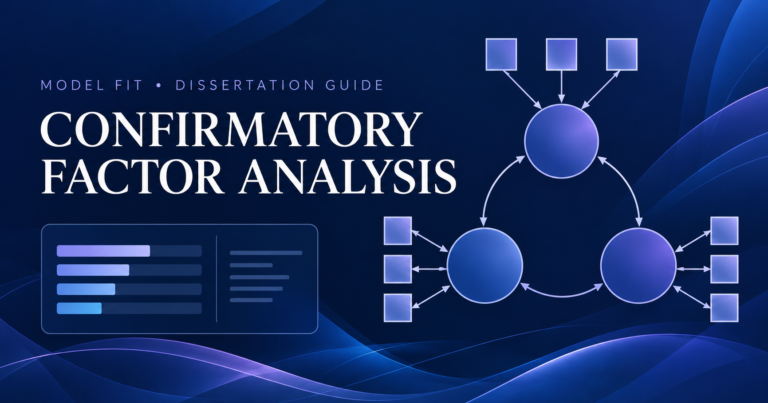 Confirmatory Factor Analysis Results: Read Model Fit Without a Magic Cutoff
 How to Justify Dissertation Sample Size: Power, Precision and Recruitment
 How to Write Research Limitations Without Undermining Your Findings