ACADEMIC SUPPORT · REVIEW METHODS
Rayyan Screening Workflow for a Systematic Review: Decisions and PRISMA Counts
Turn imported search records into transparent inclusion decisions without losing the audit trail.
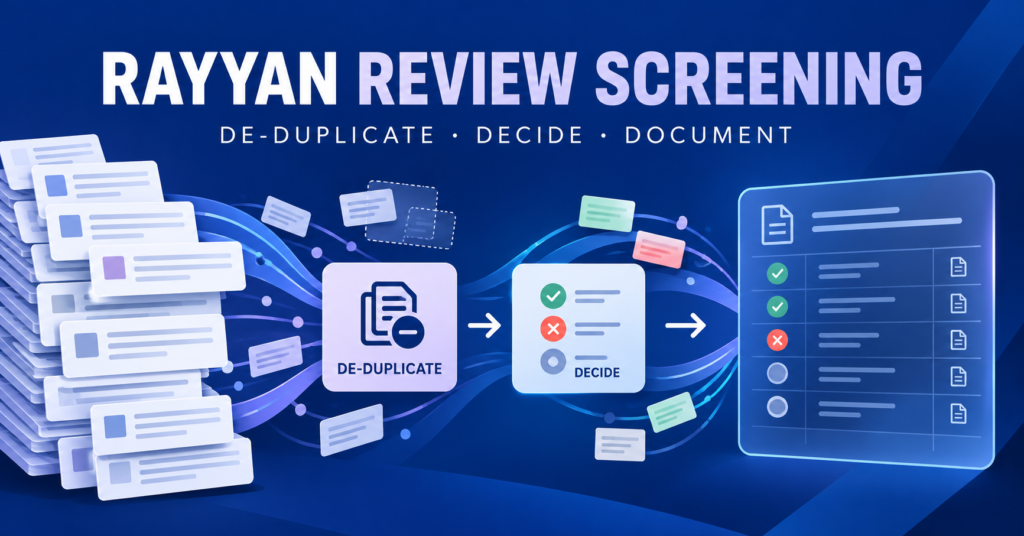
Use Rayyan after your review question, eligibility criteria and database searches are documented. Import and check the search records, resolve duplicates before screening, let reviewers apply the agreed criteria independently where the protocol requires it, resolve conflicts transparently, then assess retrievable full texts. Export decisions and reconcile the counts needed for a PRISMA 2020 flow diagram. Rayyan helps organise decisions; it does not decide whether a study truly fits your question or replace a reproducible search method.
This is an independent workflow guide, not a Rayyan product endorsement or an official tutorial. The tool’s current help centre describes its review stages and functions; your institution, protocol and software plan determine what you should use. Labeeb’s scoping-versus-systematic review guide helps choose the review type. Here the focus is the narrower screening task after a method has been chosen.
Prepare the review decisions before opening the screening queue
Write inclusion and exclusion rules that two reviewers can apply to the same abstract. Specify population or setting, phenomenon or intervention, study design, date range, language limits and publication type only where justified by the question. Define what to do when information is missing at title-and-abstract stage: a promising but unclear record should usually move to full-text review rather than be excluded on a guess. Save the full database search strings, search dates, platforms, exported files and any supplementary source searches outside Rayyan as part of the reproducible record.
Question and criteria
What must a report contain to be eligible, and which exclusions can be decided from the abstract alone?
Reviewer rules
Who screens each stage, independently or jointly, and how are uncertain records and disagreements resolved?
Count ownership
Who records imported, deduplicated, screened, retrieved and excluded counts for the review report?
Rayyan’s screening-criteria guidance shows how to configure rules in the tool. The review protocol remains the authority for eligibility. If a rule changes after screening starts, date and explain the amendment instead of silently applying different standards to earlier records.
Import complete searches, then resolve duplicates
Import each database export with enough bibliographic detail to identify records later. Rayyan’s import guide recommends testing a small sample to verify field mapping. Compare the number in each source file with the imported count, and retain the originals. A title, abstract or DOI lost during conversion can make an eligible record harder to screen.
After all planned sources are imported, use Rayyan’s possible-duplicate detection. Its duplicate guide distinguishes machine detection from human resolution and cautions against resolving duplicates after screening has begun. Review ambiguous pairs: similar titles can represent different reports, and one study can produce more than one legitimate report. Record what was removed as duplicate, what was retained and any manual correction.
Screen titles and abstracts with consistent decisions
Rayyan’s screening guide describes include, exclude and maybe decisions. Apply your protocol’s rules, not the convenience of a highlighted keyword. A record can use different terminology while still answering the research question. Where two reviewers are expected to work independently, Rayyan’s Blind Mode guidance says decisions remain hidden from the other reviewer while the mode is on; the owner can turn it off after screening to resolve conflicts.
| Record example | Reasoned action at abstract stage | What to record |
|---|---|---|
| Clearly wrong population and setting | Exclude if the protocol criterion is explicit and the abstract is sufficient. | Decision and concise reason consistent with the rule. |
| Relevant question but study design unclear | Retain or mark uncertain for full-text checking; avoid inventing missing design detail. | What remains unknown and who will decide. |
| Two reviewers disagree on eligibility | Resolve through the prespecified consensus or adjudication procedure. | Original decisions, final decision and how it was reached. |
The independent decision history matters. Rayyan’s conflict-resolution guidance explains its current consensus and majority settings and advises keeping an external disagreement record when protocol reporting requires one. Do not change review rules halfway through simply to eliminate conflicts.
Move from records to full-text reports
Once title-and-abstract decisions are settled, retrieve the full reports for the potentially eligible records. Keep a separate status for reports that cannot be obtained after a reasonable, documented attempt. At full text, apply the complete eligibility criteria and give a primary reason for each exclusion using the categories defined in your protocol. Rayyan’s full-text screening instructions describe how its next-stage decisions work, but the scientific decision remains yours.
One report is not always one study, and one study can be described in multiple reports. Check identifiers, sample descriptions, recruitment dates and author groups before counting included studies. If full-text reports overlap, do not label them database duplicates automatically; they may provide complementary information from the same research project. The PRISMA 2020 statement and its explanation distinguish these units for transparent reporting.
Reconcile the PRISMA flow with a simple count ledger
The following fictional numbers demonstrate the arithmetic. They do not describe a real Labeeb review or a Rayyan auto-generated figure. Adapt the stages to the official PRISMA 2020 flow template and your sources.
| Stage in a fictional review | Count | Reconciliation question |
|---|---|---|
| Database records identified | 200 | Do source-export totals add to 200? |
| Duplicate records removed before screening | 35 | Are 165 unique records retained? |
| Records screened at title/abstract | 165 | Do all included, excluded and unresolved records reconcile? |
| Records excluded at title/abstract | 95 | Are 70 reports then sought for retrieval? |
| Reports not retrieved | 10 | Are 60 full texts assessed? |
| Reports excluded after full-text assessment | 45 | Do reasons add to 45? |
| Reports included | 15 | Have included studies and reports been counted separately where needed? |
The arithmetic is 200 − 35 = 165 screened; 165 − 95 = 70 sought; 70 − 10 = 60 assessed; 60 − 45 = 15 included reports. If the count does not reconcile, return to the saved export, duplicate decisions, stage transitions and exclusions before drawing a polished figure. PRISMA’s explanation and elaboration asks authors to report who screened records, how disagreements were resolved and how automation, if used, affected the flow. Do not claim double screening or AI exclusion unless it actually happened.
Export the audit trail before drafting the results
Rayyan’s export guidance covers references and decisions from screening stages. Export and securely retain the final decisions, exclusion reasons, duplicate log and source files according to your institution’s data policy. Check the exported totals against the count ledger. A screenshot of the interface is not a substitute for the records and protocol choices that produced a decision.
Search evidence
Database name, exact search string, date, export file and number identified.
Screening evidence
Eligibility rule version, reviewer assignments, independent decisions and conflict resolution.
Reporting evidence
Deduplication record, retrieval status, full-text exclusions and reconciled PRISMA counts.
A literature review is not complete when the final include button is pressed. The dissertation or manuscript must also synthesise what eligible studies say, how trustworthy they are and where the evidence is limited. If your protocol calls for risk-of-bias or critical-appraisal work, plan that separately from initial screening.
Sources checked: Rayyan overview, duplicates, Blind Mode, exports, and PRISMA 2020 flow diagram. Tool screens and plan features may change; verify the current version for your project.
Make your review decisions reproducible
If your search, screening criteria or PRISMA counts do not reconcile, Labeeb can scope ethical literature-review support around your approved question, source files and institution requirements. We can help organise the evidence trail and explain the method; your research team retains inclusion decisions, appraisal and authorship. Share your review stage and current records for a consultation.
More Academic Support guides
 Exploratory Factor Analysis Results: Interpret Loadings, Rotation and Cross-Loadings
 PubMed Search Strategy for a Literature Review: MeSH, Keywords and a Reproducible Log
 Confirmatory Factor Analysis Results: Read Model Fit Without a Magic Cutoff
 Dissertation Data Analysis Plan: Map Questions to Variables and Tests