Best CV Format for Dubai: A Complete Guide for Job Seekers (2026)
Most CVs sent to Dubai employers are rejected by software before a person reads them, and the cause is almost always formatting rather than experience. This guide sets out the format that survives applicant tracking systems here, the local conventions that differ from other markets, and a structure you can apply to your own document today.
Applying from outside the UAE? Our Gulf pre-arrival readiness checker shows which documentation gates — attestation, verification, translation — apply to your destination and profession before the CV even matters.
Download the Free UAE CV Template (ATS-Ready)
Every rule in this guide is already built into our free template: single-column ATS-safe layout, UAE header fields (location, visa status, availability), achievement-bullet prompts and a one-page how-to. No sign-up, no email — just the file.
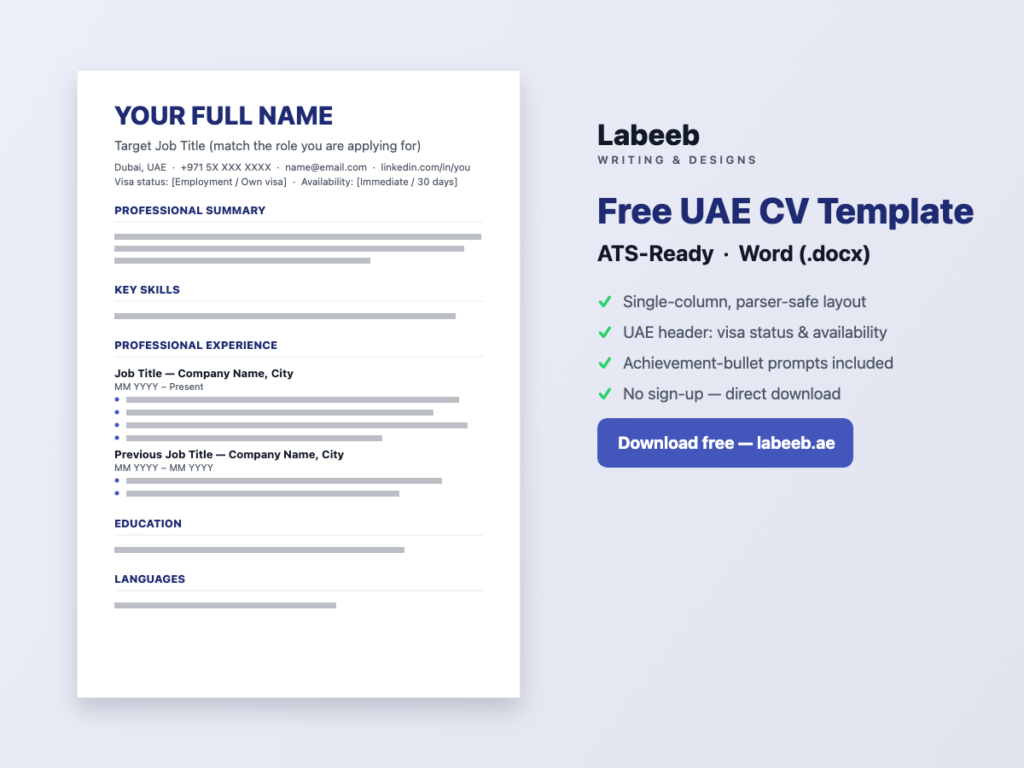
Download the template (.docx)Prefer it written for you? After filling it in, run it through our free ATS CV checker to confirm it parses cleanly.
Labeeb · Career Services
Prefer to have your CV written for you instead of filling in the template?
Labeeb writes ATS-aligned CVs by career level, from AED 100 at entry level.
Your CV is read by software first
Almost every employer of scale in Dubai — government entities, semi-government groups, banks, airlines, multinationals — receives applications through a portal that parses your document into structured data before a recruiter sees anything. The parser extracts your name, contact details, employment history with dates, qualifications and skills, then scores the result against the job description.
This has one blunt consequence: a beautiful CV that parses badly loses to a plain CV that parses cleanly. Design does not survive the extraction step, and what is not extracted does not exist.
ⓘ Test your own document in thirty seconds. Open your CV, select all, copy, and paste into a plain text file. What appears is roughly what the system reads. If the order is scrambled, if columns have merged into nonsense, or if whole sections vanish, that is what a recruiter’s shortlist is being built from.
The formatting rules that decide whether you are read
One column, never two. The two-column template is the most common single cause of parsing failure. Systems read left to right across the page, merging the sidebar into the main text and producing gibberish.
Nothing important in the header or footer. Many parsers ignore those regions entirely. Your phone number and email belong in the body of the first page.
No text inside images, charts or text boxes. Skill rating bars, infographics and logos contribute nothing and can break extraction. If a fact matters, it must be live text.
Standard section headings. “Professional Experience”, “Education”, “Skills”, “Certifications”. Creative alternatives — “My Journey”, “What I Bring” — may not be recognised as sections at all.
Consistent date formats. Pick one, such as 03/2021 – 07/2024, and use it everywhere. The system calculates your years of experience from these, and inconsistent formats produce wrong totals.
Standard fonts, .docx by default. Word format parses most reliably unless the portal specifically requests PDF. Never submit a scanned or image-based file — it extracts to nothing.
Two pages is normal here. The one-page convention imported from other markets causes candidates to delete the scope evidence UAE recruiters screen for. Cut weak content, not length. Senior candidates often ask how far past two pages they may go; see the UAE CV length rules for senior roles.
The section order that works for Dubai applications
1. Contact details — name, phone with country code, email, city and country, LinkedIn URL. In the body, not the header.
2. Professional summary — three or four lines naming your specialism, years of experience and sector, using the vocabulary of the advert.
3. Professional experience — reverse chronological. Job title, employer, location, dates, then achievements with numbers rather than duty lists. “Managed a team” says nothing; “managed 12 staff and cut cycle time 30%” says everything.
4. Education — degree, subject, institution, year. UAE employers commonly require attested certificates, and your qualification determines your work permit classification — see degree attestation for a UAE employment visa.
5. Certifications and licences — full names, issuing bodies, dates. Critical in regulated fields, where the licence is assessed before the CV.
6. Skills — a plain text list mirroring the job description. No rating graphics.
7. Languages — with an honest, specific level. Arabic is a genuine advantage in government-linked and client-facing roles.
What differs in Dubai from other markets
Photos, nationality and personal details. Conventions vary by employer and several portals have structured fields for these. Where the portal asks, fill the field and leave it off the document; where it does not, the safer default is to omit. Detailed guidance: photo, nationality and visa status on a UAE government CV.
Visa status. Stating your current status plainly — employment visa, residence visa, visit visa, or requiring sponsorship — saves a round of questions and is expected.
Notice period. UAE employers plan around start dates. Including yours is normal and helpful.
Name consistency. The name on your CV, your passport and the portal record must match exactly. A middle name present on one and absent on another is a genuine source of delay at verification.
Government applications are different again. They verify eligibility and documentation before assessing achievement — see the best CV format for Dubai government jobs and how to apply for government jobs in Dubai.
GCC CV Format Decision Tool
The rules above are the Dubai baseline. The right format still shifts with the country, the sector, your level and where your CV comes from. Choose your situation and get a format card: length, section order, which personal details to include, language, file type and, if you are applying from abroad, exactly what to change in your home-country CV. Nothing you choose is stored.
This is practice guidance, not legal advice. Where the card cites law, it links the official text: UAE Federal Decree-Law No. 33 of 2021 (MoHRE); Saudi Labor Law and its amendments (HRSD); the UAE Nafis programme. Employers’ own application forms and portals always take precedence. Last checked: 22 September 2026.
Matching the advert without keyword stuffing
The parser compares your vocabulary against the job description, but stuffed keyword lists fail at the human review immediately afterwards. The approach that survives both:
Read the advert and extract its recurring terms — the systems, tools, standards and job titles it actually uses.
Use those terms inside real achievements, not in a separate block at the end.
Write acronyms and their full form together at first mention, since the system may search for either.
Tailor per application. A single CV sent to twenty adverts matches weakly against all twenty. Twenty minutes of tailoring outperforms a hundred generic submissions.
Sources & further reading
The employment framework these applications sit inside is published by the regulator, and the portal you are applying through is the authority on its own requirements:
— MoHRE: private-sector employment regulation, work permit categories and Emiratisation obligations.
— u.ae employment services: the federal index of official employment channels.
— Dubai Careers: the Dubai Government recruitment platform, and the source for its own upload requirements.
Related guides: ATS-friendly formats for UAE employers · writing an ATS resume for any industry · landing more interviews with an ATS-optimised CV.
ⓘ Labeeb’s reading. The single change that moves outcomes most is not a template — it is replacing duty statements with sized achievements. Recruiters in Dubai screen hundreds of near-identical CVs for the same role; the ones that advance are the ones where the scope is visible in numbers on the first page. Everything else on this page is the plumbing that gets your document read at all. Sources verified live in August 2026.
If you would rather have it done
Labeeb writes ATS-ready CVs for the UAE and GCC market, built against the portal rules above and tailored to your target roles: professional CV writing. If you want the applications handled with you, job application support covers submission and tracking as well.
Speak with Labeeb before you decide.
Use this article as a guide, then choose the support route that fits your document, deadline and market.
How to Make a CV for a Job in Dubai or the UAE
- Start from a clean, single-column layout — no tables, text boxes or graphics that break ATS parsing.
- Open with a 3–4 line professional summary naming your role, years of experience and target sector.
- Add UAE context up front — location, visa status and availability, so recruiters can qualify you instantly.
- Write achievement bullets, not duty lists — quantify results and mirror the keywords of the role you want.
- Keep it to two pages (three only for senior executives), save as .docx or text-based PDF, and match your LinkedIn profile to it.
The sections below cover each of these steps in detail, with the formats UAE and Dubai employers actually shortlist from. Agencies read differently from in-house recruiters; we cover how to write a CV that UAE recruitment agencies actually read separately.